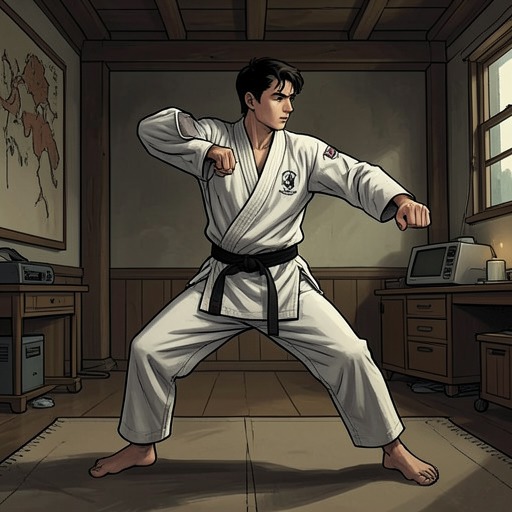
Daily posture is combat posture
The Book of Five Rings日常姿态即战斗姿态 is a foundational rule in Miyamoto Musashi’s account of strategy: the stance cultivated for combat should also govern everyday life. It joins posture, gaze, grip, and movement into a continuous discipline, so that readiness is not a special pose adopted at the moment of danger but a way of maintaining the body and attention across circumstances.
The Everyday Combat Stance
The instruction begins with the body’s alignment. The head is held erect, neither bowed nor lifted, and kept free of twists; the brow and space between the eyes are relaxed, the eyes slightly narrowed rather than rolling or blinking, and the nose held straight. The shoulders are lowered, the neck kept straight, and strength carried through the body into the legs and toes. The abdomen is braced so the hips do not bend. Even the equipment is incorporated into the stance: the 胁差 is wedged in the belt against the abdomen, with the belt kept taut. The detail makes readiness a coordinated bodily condition, not merely an upright pose. The rule is explicit that everyday stance should become combat stance and combat stance everyday stance. This reciprocity removes a boundary between training and use: the body is not to wait for a formal encounter before taking up its disciplined form. The broader purpose is practical steadiness. The text insists that strategic principles must be researched continually, even under pressure, so that the spirit remains steady; habitual posture is one means of making that composure available when circumstances become difficult.
Attention and Perception
The continuity extends from posture to seeing. The gaze should be broad, joining perception with sight, and should hold distant things as though near while viewing nearby things from a distance. In combat, this means recognizing the enemy’s sword without becoming distracted by insignificant movements of it. The same gaze is prescribed for single combat and large-scale strategy, linking the immediate encounter to the wider field of judgment. This trained attention should not depend on conspicuous eye movement. The practitioner is told to look to both sides without moving the eyeballs, an ability not mastered quickly, and to use the gaze in everyday life without varying it whatever happens. Thus the daily discipline is not simply physical rehearsal: it trains a stable mode of attending, one that takes in the field broadly while distinguishing consequential movement from distraction.
Grip and Footwork
The same principle governs handling the 长剑. The thumb and forefinger hold it with a comparatively floating feeling, the middle finger neither tight nor slack, and the last two fingers firmly closed; the hands should have no play. Yet the grip must not become fixed. It remains intent on cutting, while changing slightly at the thumb and forefinger when the sword is used to dash aside, ward off, or force down an opponent’s weapon. A rigid hand is described as dead, pliability as living. Readiness therefore depends on a trained hold that can adapt without losing its purpose. Footwork likewise keeps combat movement within the ordinary rhythm of walking. The toes are somewhat floating while the heels tread firmly; steps may be fast or slow, large or small, but the feet should move as in normal walking. The method rejects jumping, floating, and fixed steps, and calls for alternating the feet left and right rather than preferentially moving on one foot. The contrast is telling: the everyday is not abandoned for an artificial fighting gait; ordinary locomotion is refined into a balanced, responsive practice.
Contact, Action, and Strategic Reach
In close engagement, the rule develops into whole-body action. The instruction called Glue and Lacquer Emulsion Body requires the practitioner to stick to the enemy rather than separate, bringing head, body, and legs forward together so that the body does not lag behind the advancing head and legs. Its concern is the gap between bodies: closing that gap prevents the opponent from regaining distance and turns physical continuity into a tactical advantage. The Body Strike makes the principle more forceful. The practitioner enters through a gap in the enemy’s guard, turns the face slightly aside, and thrusts the left shoulder into the enemy’s breast, coordinating the impact with the breath. The text says that a successful strike can send an opponent ten or twenty feet away and can be continued until he is dead. The daily rule thus does not mean passive composure; habitual bodily organization supports decisive action when an opening appears. This practical discipline belongs to a strategy whose aim is not limited to small technical contests. Miyamoto Musashi distinguishes his method from narrow dexterity and argues that it must work against an individual or many opponents, including in the conditions of full armour. Training with a sword alone is presented as a way to understand an enemy’s strategy, strength, and resources, then extend that understanding to conflict on a much larger scale. The trained body is therefore part of a wider strategic method: individual posture and movement are the ground from which judgment can reach beyond the individual encounter.
Scope and Significance
The principle sits within the book’s five-part design, which ranges across Ground, Water, Fire, Wind, and Void. Its emphasis on repeated bodily research belongs to a work that treats strategy as more than sword-fencing: the practitioner is asked to understand small and large matters, and to carry principles learned in one setting into others. Everyday stance is one concrete expression of that transfer, joining personal habit to combat readiness and individual technique to strategic judgment. The rule also fits the book’s account of the warrior’s discipline as sustained practice directed toward overcoming opponents. It does not offer a single fixed pose to preserve at all costs; the accompanying instructions insist on pliable hands, alternating footwork, broad perception, and coordinated movement. Its central demand is continuity without rigidity: the body should remain prepared in ordinary life precisely because effective action requires both steadiness and adjustment.